

FREE SHIPPING ON ORDERS OVER €150 / £150 / $300 – ALL TAXES AND DUTIES INCLUDED

FREE SHIPPING ON ORDERS OVER €150 / £150 / $300 – ALL TAXES AND DUTIES INCLUDED

When we think of lingerie, certain materials come to mind immediately: lace, fine mesh, delicate embroidery. They’re the visual language of lingerie – what separates it from the basics, and function from fantasy.
What many people don’t realise is that almost all of these materials today are synthetic. Modern lace, embroidery and mesh – the fabrics most closely associated with lingerie today – are now made predominantly from synthetic fibres such as nylon, polyester and elastane.
So why isn’t lingerie made from natural fabrics anymore?
The answer is part history, part technology and part economics.
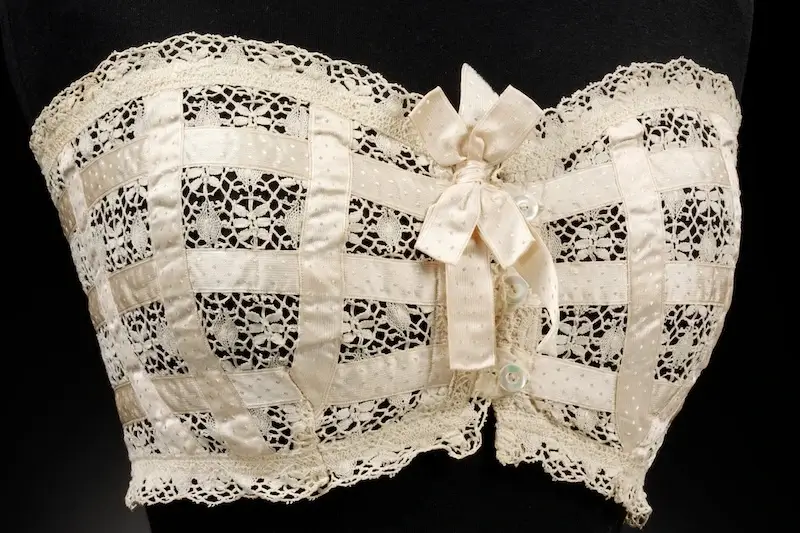
For centuries, lingerie was made entirely from natural fibres. Linen, cotton and silk dominated underwear wardrobes for centuries, long before the invention of synthetic materials. “Undressed: A Brief History of Underwear”, an exhibition by the Victoria & Albert Museum in London in 2016, explored underwear design from the 18th century to the present day – a selection of pieces can be seen in this summary by Vogue.
Lace and embroidery themselves are not modern inventions; they date back hundreds of years and were painstakingly made by hand using natural fibres. Fine lingerie was often crafted from silk, adorned with intricate lace or embroidery, and reserved almost exclusively for the wealthy. These garments were luxury objects: expensive, fragile and time-intensive to produce.
In that context, natural fibres were lingerie. But lingerie was also rare, costly and inaccessible to most people.
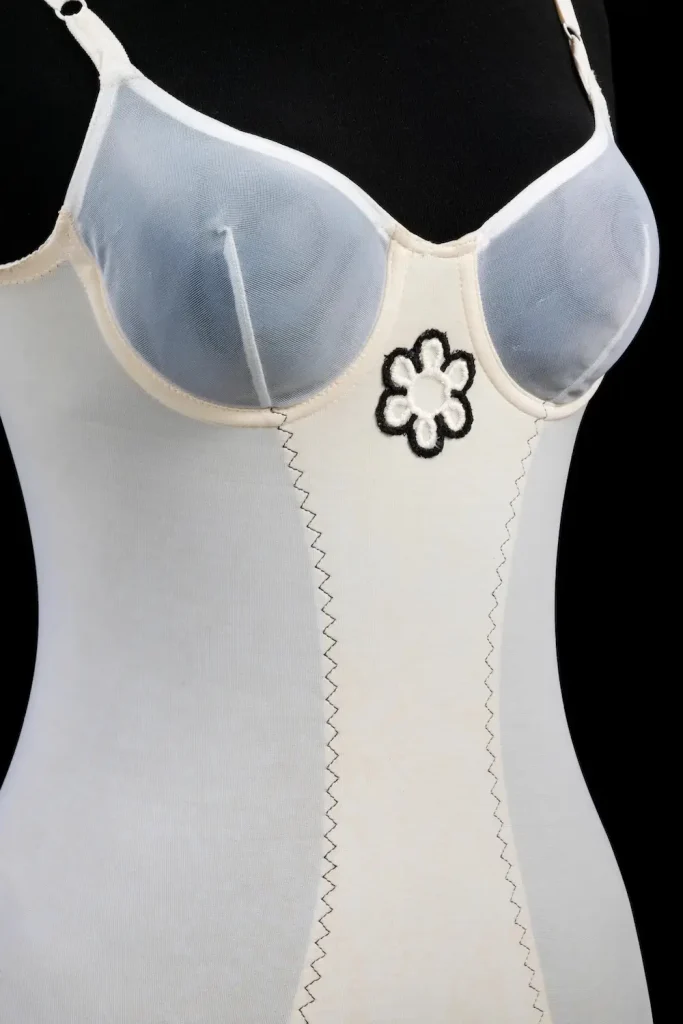
The shift away from natural fabrics began in the mid-20th century with the invention of nylon.
Nylon was revolutionary. It was strong, lightweight and, crucially, far cheaper to produce at scale than silk. It introduced something that natural fibres could not offer at scale: strength, uniformity and affordability. For the first time, it allowed manufacturers to produce delicate fabrics like lace and fine mesh – as seen, for example, in our consistently and in large quantities. Most modern lace is not woven in the traditional sense, but knitted on specialised machines using extremely fine yarns. These processes require fibres that are strong, flexible and consistent, which makes synthetic materials ideal.
This shift democratised lingerie. Styles that had once been limited to a small elite became widely available; lace bras, embroidered briefs and sheer mesh panels moved from luxury items into everyday wardrobes.
But they came with a trade-off: the transition made lingerie more accessible, but it also replaced natural fibres with synthetics almost entirely in their construction.
It might seem intuitive to return to natural fabrics, but the reality is more complex. Natural and synthetic fibres behave very differently, especially in lingerie.
Cotton is breathable and comfortable, which makes it well suited to everyday underwear. However its shorter, bulkier fibres make it less suitable for the ultra-fine, high-precision constructions required for materials such as lace and mesh, and these same fibres are less resilient when engineered into very delicate structures.
Silk can replicate much of the softness and beauty of synthetic lace, but it comes at a significant cost. Depending on quality and source, silk can be up to 20 times more expensive than nylon or polyester. While silk is surprisingly strong for its weight – one of the strongest natural fibres – it is more sensitive to moisture, friction and repeated washing, making it less suited to everyday wear. This, and the price point, place it almost exclusively in luxury bridal lingerie or haute couture, rather than everyday underwear.
Linen, while durable, is typically too coarse for the lightweight, fine structures used in modern lingerie.
There is also a fundamental constraint that often gets overlooked. Almost all modern underwear relies on some degree of elasticity to fit and move with the body, and that stretch typically comes from elastane or similar synthetic fibres. As a result, even cotton underwear is rarely made from 100% natural materials.
Without synthetic fibres, many of the features associated with lingerie today would be difficult to achieve at scale. Lingerie as we know it would become far more basic, with simpler designs, fewer sheer elements and less of the detailed finishing that elevate everyday pieces into something that feels indulgent.
Synthetic fabrics come with clear advantages, but they also raise environmental concerns.
Conventional nylon and polyester are derived from fossil fuels and are not biodegradable. They can persist in the environment for decades or centuries, and over time may shed microplastics that accumulate in ecosystems and waterways.
This creates a tension at the heart of lingerie design: the very materials that allow for delicacy, nuance and longevity are also environmentally problematic. At the same time, natural fabrics are not impact-free. They require water, land and energy to produce, and may not last as long in certain applications. If you’re interested in how these material choices translate into real-world impact, we explore this in more detail in our article on the benefits of switching to sustainable lingerie.
Durability is also part of sustainability. A well-made garment that lasts for years can have a lower overall impact than one that needs to be replaced frequently. So if natural fibres aren’t a complete solution, and traditional synthetics are clearly imperfect, where does that leave us?
In recent years, innovation has focused not on eliminating synthetics entirely, but on rethinking them.
A new category of materials has emerged: biodegradable and bio-based synthetic fibres. These are designed to behave like traditional nylon or polyester – maintaining strength, durability and finesse – while addressing their environmental impact at end of life.
Some examples include Amni Soul Eco®, a polyamide designed to biodegrade in landfill conditions in five years (that’s 10 times faster than common synthetics); Neride Bio®, a polyamide that biodegrades into biomass and methane which, when properly captured, becomes green energy; and CELYS®, the world’s first compostable polyester fibre, with over 95% decomposition in just six months.
Amni Soul Eco® is used in the lace of our Poppy collection, allowing the fabric to retain the delicacy and appearance of traditional lace while being fully biodegradable. Our Pink Poppy Lace Bodysuit (below), uses this lace alongside mesh made from fully recycled polyamide.
While each material has its own composition and process, they share a common goal: to biodegrade under specific conditions once discarded, rather than persisting indefinitely.

Unlike conventional synthetics, these fibres are engineered so that microorganisms can break down their polymer chains when exposed to environments such as landfill conditions. Instead of fragmenting into microplastics, they are designed to biodegrade into natural elements like biomass, water and gases over time.
Depending on the material and disposal conditions, this process can take a few years rather than centuries. Importantly, garments will not biodegrade in your drawer, in the wash or while you are wearing them – these materials are engineered to break down only under specific conditions and in controlled environments, when they have been disposed of after their usable life.
From a wearer’s perspective, they behave just like traditional synthetics: durable, soft, lightweight and suitable for delicate lingerie construction.
Technically, it is possible to make lingerie from 100% natural fabrics. In practice, it comes with significant limitations.
The main constraint is elasticity. Most lingerie requires stretch to fit properly and retain its shape, and this is almost always achieved using synthetic fibres such as elastane or spandex. While natural rubber can provide elasticity, it is rarely used in modern underwear due to cost, durability and manufacturing constraints (as well as the risk of latex allergies).
This means that even garments labelled as cotton underwear (as cotton itself has very little natural elasticity) typically contain a small percentage of synthetic fibres to allow for stretch and recovery, and even the most minimal underwear today often depends on small amounts for fit and function.
The question is not simply whether lingerie can be made from natural fabrics, but what is lost when it is. Fully natural underwear can exist, but it would look – and feel – very different.
It’s important to be clear: biodegradable synthetics are not a silver bullet.
They still require industrial processes to produce. They still rely on infrastructure and responsible disposal to realise their full benefits. And they don’t replace the need to reduce overproduction or overconsumption. But they represent a meaningful step forward, particularly in categories like lingerie, where natural alternatives are genuinely limited.
The conversation around sustainability often frames “natural” as inherently good and “synthetic” as inherently bad. Lingerie complicates that narrative.
The reality is that lace, embroidery and mesh – the materials that give lingerie its character – are extremely difficult to achieve at scale without some form of synthetic fibre. At the same time, natural fibres are not without impact: they require significant land, water and energy to produce. No material exists without trade-offs.
The question, then, is not whether lingerie should use synthetics at all, but which synthetics we choose, how they’re produced, and what happens to them at the end of their life.
At Luciela, that means prioritising recycled fibres and biodegradable synthetics, always with a focus on longevity, wearability and thoughtful design. You can explore this further on our Materials page, or on our individual product pages where we provide a complete breakdown of every single material used in each product.
Because sustainability in lingerie isn’t about pretending complexity doesn’t exist. It’s about working within it, honestly.
More articles
We use cookies to improve your experience and to analyse our traffic. By continuing to browse, you agree to our use of cookies.
